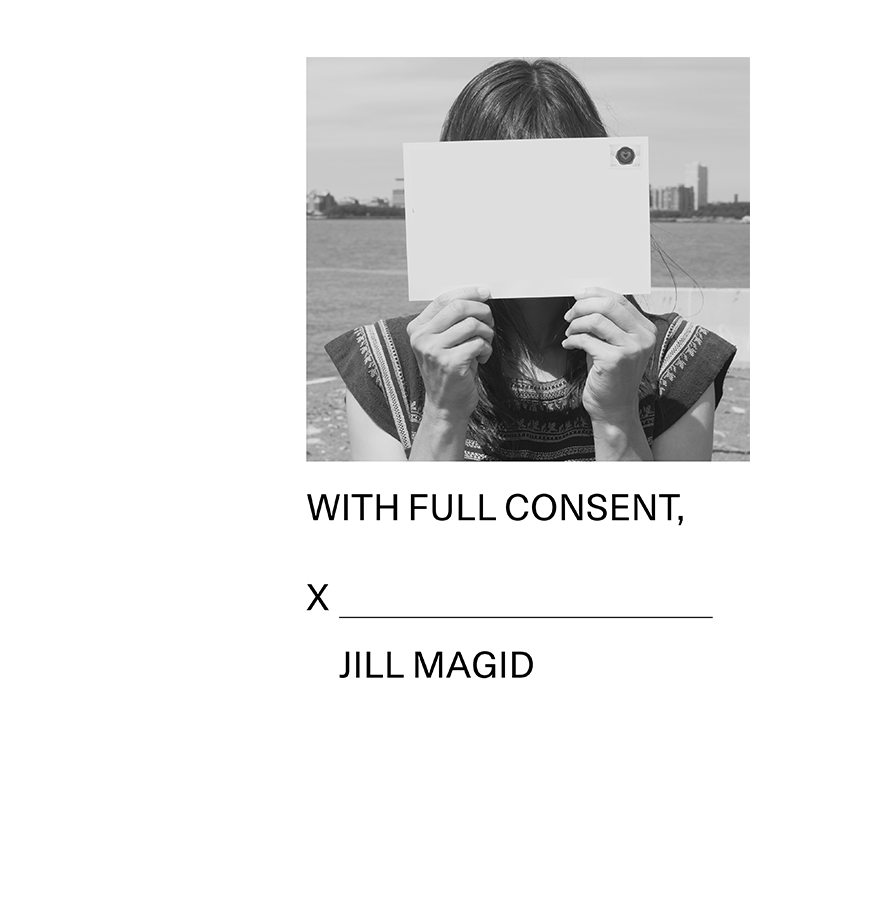
With Full Consent, Jill Magid

Copublished with Creative Time, in 2026
With texts by Tyler Coburn, Jackie Sibblies Drury, Jarrett Earnest, Randy Kennedy, Justine Ludwig, Cuauhtémoc Medina, Gilda Williams
Design by Chad Kloepfer
Edited by Karen Kelly and Barbara Schroeder
272 pages, 166 color images, softcover with jacket, 9 x 11 1/4 inches
ISBN: 9781954947214

$40.00

Awaiting Stock. Available for Preorder

With Full Consent, Jill Magid is the first comprehensive monograph on American artist Jill Magid, whose provocative and genre-defying work spans more than two decades. Known for navigating—and reshaping—the boundaries between art, institutions, and power, Magid has developed a practice that treats legal codes, surveillance systems, and bureaucratic infrastructures as both medium and collaborator. Across sculpture, installation, performance, text, and moving image, Magid interrogates structures of power on an intimate level, often forming long-term relationships with governmental and corporate systems – among them police departments, intelligence agencies, surveillance networks, and restricted archives – following their rules of engagement to the letter. Her work explores the emotional, philosophical, and legal tensions that exist between institutions and individual agency, often taking the form of a love story between artist and bureaucracy.

Rather than merely documenting her body of work, With Full Consent enacts Magid’s conceptual approach, unfolding as a work of art in its own right. Like Duchamp’s Boîte-en-valise, the book serves as a resonant distillation of a career spent sculpting relationships and infrastructure. From CCTV grids to posthumous image rights, Magid reveals the unseen architectures that govern contemporary life—rendering them newly visible, poetic, and profoundly human. At once a monograph and a cultural object, With Full Consent offers a revelatory overview of a practice that has redrawn the contours of what art can be—and where it happens.

Jill Magid is an artist, writer, and filmmaker based in New York. She was born in Bridgeport, Connecticut, and received a BFA from Cornell University and an MS in Visual Studies from the Massachusetts Institute of Technology. The artist has staged solo exhibitions at major museums across the globe, including Tate Modern, London (2009); Whitney Museum of American Art, New York (2010); Kunsthalle Sankt Gallen, Switzerland (2016); Museo Universitario Arte Contemporáneo, Mexico City (2017); Dia Bridgehampton, New York (2020); The Renaissance Society, Chicago (2021); Modern Art Museum of Fort Worth (2022); Centre Pompidou, Paris (2022), and M Leuven, Belgium (2023), among others. She has participated in major group exhibitions worldwide, including the Liverpool, Lyon, Bucharest, Singapore, Incheon, Gothenburg, and Performa Biennials, as well as Manifesta.

Reviews


In her work, the road bends, dips, passes scenic viewpoints; she stops to smell the flowers and speak with a local. Yet her sense of whimsy is also a means of subterfuge, a tool to cut through the red tape surrounding bureaucracies and expose their inner workings. Magid, born in 1973, fosters unwieldy real-life scenarios involving police departments, electoral campaigns, artists’ estates, intelligence agencies, surveillance apparatuses, and the individual actors who keep them running. As her artworks progress, often over the span of years, Magid navigates and agitates the power dynamics at the heart of institutional life. She documents these choose-your-own-adventure performances with an array of media: photographs, novellas, films, readymades, light installations, and ephemera like handwritten notes and letters. … A new book surveying her career, With Full Consent, Jill Magid, foregrounds the renegade measures the Connecticut-born, New York-based artist takes to fulfill her visions. … Indeed, Magid’s protean, adaptable conceptualism welcomes foibles, fallibility, emotion, egotism, and desire: tender spots in people that are also potential vulnerabilities in seemingly impervious structures of power.

—Daniel Felsenthal, Jewish Currents